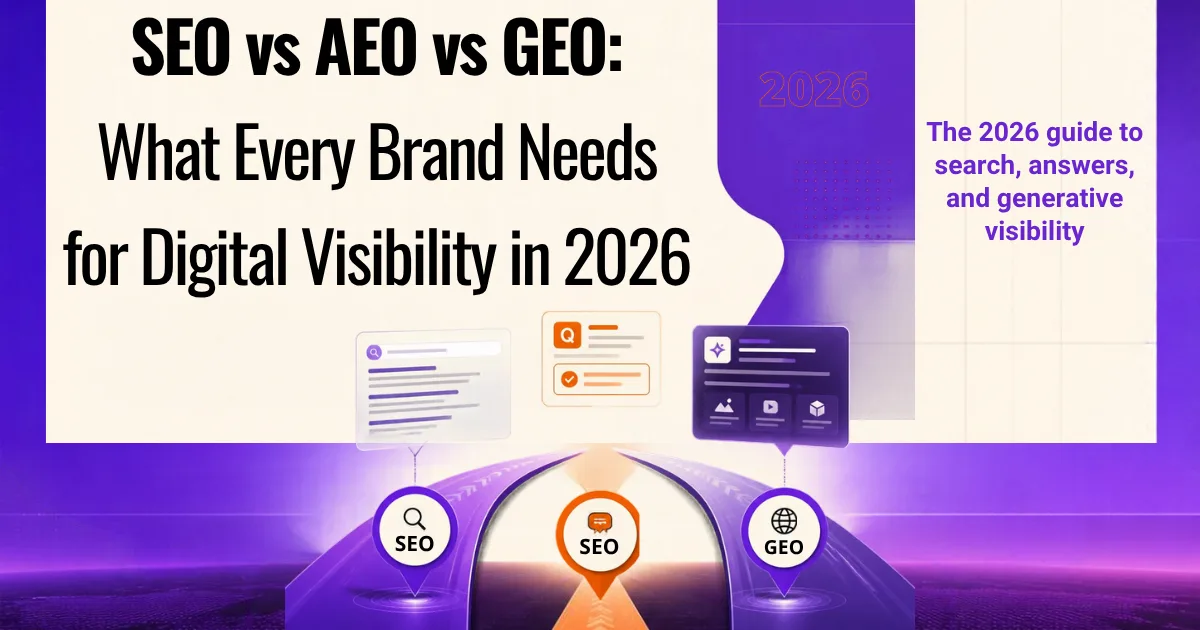
If your digital strategy in 2026 still depends only on traditional SEO, your visibility is already shrinking. People aren’t browsing hundreds of websites anymore. Google’s AI Overviews are summarising answers instantly, and Generative AI platforms are becoming the first place audiences turn for information. If your brand isn’t optimised for how AI delivers answers, you’re slowly disappearing from the conversation.
All three approaches complement each other: SEO gets your website onto the SERP, AEO gets your content into zero-click search, and GEO gets your content cited inside AI-generated responses. The end goal of all three is the same - maximising a brand's digital visibility and authority.
What is SEO in Digital Marketing?
In digital marketing, SEO (Search Engine Optimization) is the process of improving a website so it appears higher in organic (non-paid) search results on search engines like Google. The goal is to make your website more visible when people search for relevant topics, products, or services.
Different Components of SEO
- Keywords: Short-tail keywords (short, high-volume) and long-tail keywords (longer, more specific, clearer intent).
- Search Intent: Why someone is searching — Informational (seeking answers), Navigational (looking for a specific site), Commercial (comparing products/reviews), and Transactional (ready to buy or subscribe).
- Types of SEO: On-page (optimising individual pages), Off-page (external activities that build traffic and authority), Technical (site structure and navigability), and Local (Google Business Profile and local search).
How Should Brands Approach SEO in 2026?
Despite the rise of AEO and GEO, SEO remains just as important — the AI-generated answers behind AEO and GEO exist because the source website has a solid SEO foundation. Brands need to build topical authority to rank higher, signalling real domain expertise. In 2026, SEO rewards content quality and depth over sheer volume.
What is AEO?
In digital marketing, AEO (Answer Engine Optimization) is the process of optimizing content so search engines and AI systems can directly display it as an answer to users’ queries. Specifically, it focuses on making content clear, structured, and easy to extract for zero-click search experiences.
What Are the Key Components of AEO?
- Featured Snippets: Pull an answer from one webpage into "Position Zero" at the top of results, saving users time.
- Google AI Overviews: Google's AI synthesises information from multiple sites into its own summary, with source links attached, tailored to the search query.
- Voice Search Optimization: Voice assistants read out the single most direct answer, often pulled from local content.
- People Also Ask: Surfaces related questions so users can explore beyond their original query.
How Should Brands Use AEO in 2026?
Brands must structure content properly — using structured data, schema markup, and meta tags — so it surfaces in zero-click searches. With zero-click search on the rise, the focus should shift from website-visit metrics to action and conversion metrics.
What is GEO (Generative Engine Optimization)?
In digital marketing, GEO (Generative Engine Optimization) is the process of optimizing content so AI systems and generative search tools can understand, trust, and cite it in AI-generated answers and responses.
Different Components of GEO
- E-E-A-T Signals (Experience, Expertise, Authoritativeness, Trustworthiness): show real experience through case studies, expertise through credentials, authority through backlinks and mentions, and trustworthiness through accurate, secure, transparent content.
- LLM Optimization (Large Language Model): improves the odds of being cited by tools like Perplexity, Gemini, and ChatGPT through clear headings, simple and precise language, an FAQ format, up-to-date content, and a logical flow that's easy for both AI and readers to follow.
Generative Engine Optimization for Brands in 2026
In 2026, brands need to optimise for recall, not just ranking — the real question is how to get cited in Google AI Overviews and ChatGPT answers. To improve GEO visibility, create clear, well-structured, trustworthy content: cover related subtopics, keep information current, use headings and FAQs, and build strong topical authority.
What is the Difference Between SEO, AEO and GEO?
| Aspect | SEO | AEO | GEO |
| Full form | Search Engine Optimization | Answer Engine Optimization | Generative Engine Optimization |
| Primary goal | Rank higher on search engine results pages (SERP) | Appear as direct answers in zero-click search | Get understood, trusted, and cited in AI-generated responses |
| Where visibility happens | Organic search results | Featured snippets, AI overviews, voice search, People Also Ask | AI platforms such as Perplexity AI, Gemini AI, and ChatGPT |
| How users interact | Clicks through to websites | Often get answers without clicking | Receives AI-generated responses that may cite sources |
| Main focus | Ranking web pages for relevant keywords and search intent | Structuring content so search engines can extract direct answers | Creating content AI systems can understand, trust, and reference |
| Key components | Keywords, search intent, on/off-page, technical, and local SEO | Featured snippets, AI overviews, voice search optimization, People Also Ask | E-E-A-T signals and LLM optimization |
| Content style | In-depth, high-quality topical authority | Clear, structured, easy-to-extract answers | Clear headings, simple language, FAQs, logical flow, latest and relevant content |
| Brand priority in 2026 | Build strong SEO foundations | Be visible in zero-click search experiences | Be remembered and referenced by AI systems |
Conclusion
In 2026, the conversation around SEO vs AEO vs GEO is no longer about choosing one over the other. Each plays a different role in how brands are discovered. SEO builds the foundation for search visibility, AEO helps content surface in zero-click answers, and GEO improves the chances of being referenced in AI-generated responses. For brands focused on brand visibility in AI, the priority is to create clear, structured, trustworthy content that works across traditional search and generative search experiences. As AI search optimization in 2026 in India continues to evolve, brands will need to focus differently on SEO, AEO, and GEO, but the strongest digital presence will come from combining all three.