
The National Medical Commission (NMC) recently released new rules and guidelines regarding medical advertisements and promotions, which apply to individual registered medical practitioners (RMPs) as well as hospitals and medical institutions.
Earlier it was only private doctors that had strict restrictions on promoting their practice, while hospitals had fewer regulations. These new regulations bridge the gap by creating a common framework for both doctors and hospitals. The aim is to provide factual, ethical, verifiable healthcare communication, rather than solicit patients or promote commercialized medical care.
The guidelines of ethical advertising and public communication for hospitals, medical institutions and doctors was issued on 06th October, 2026, and had been put to effect immediately.
What is Prohibited in Marketing for Medical Practitioners Establishments?
In terms of marketing and advertising, practices that solicit patients, promote commercial medical care, AI generative content, and similar implementations are forbidden to be used.
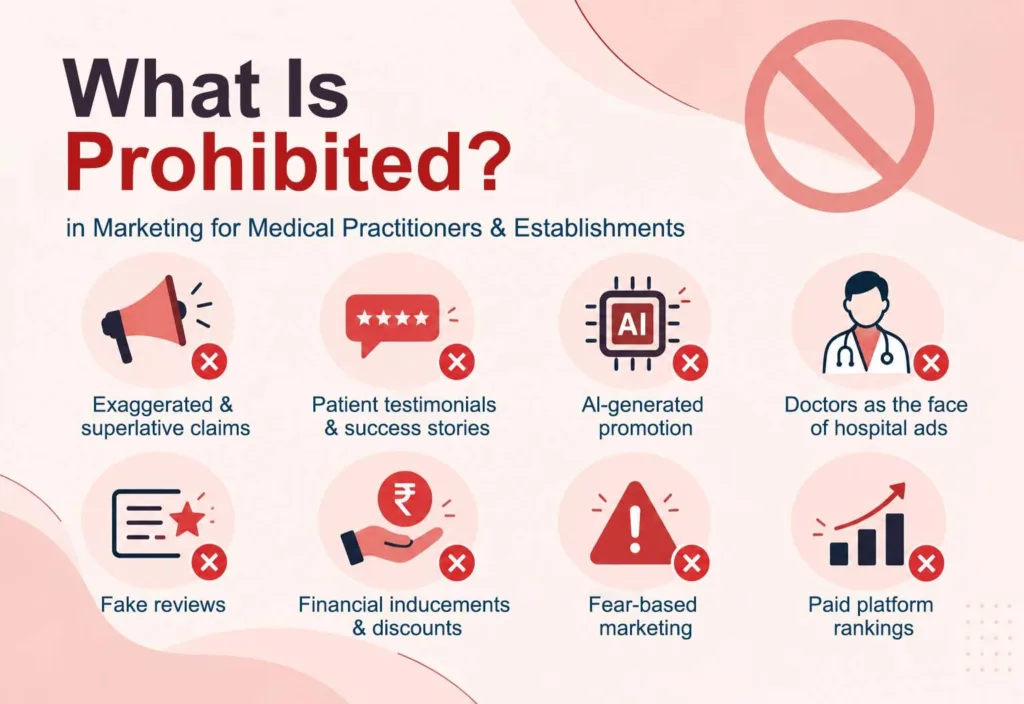
1. Exaggerated and Superlative Claims
Using terms like "best doctor," "No. 1 hospital," "100% cure/success guaranteed,” "guaranteed cure,” “painless treatment,” or “most trusted” are exaggerated and unverifiable claims. They cannot be assessed by the patients, and hence, can lead to falsely promoting the practice or clinical establishment.
2. Patient Testimonial and Success Stories
Showcasing before and after treatment pictures, video testimonials, celebrity patients, and procedure results are forbidden to be used in marketing. However, these photo and video results can be used for scientific and educational purposes, provided the patient has given their consent and anonymity is pertained where required.
3. AI Generated Promotion
Doctors or medical institutions cannot use AI generated content to commercially promote their services. AI cannot be used for the ill-intent of manipulating patient voice, images, videos, or clinical results to show the doctor or hospital in a false positive light. However, if the material is created for the purpose of audience understanding, then appropriate disclosure should be made.
4. Doctor as the Face of Hospital Ads
Hospitals, medical institutions and clinical establishments cannot use individual doctors as a promotional figure to attract patients. Their personal achievements and accomplishments cannot be used as a promotional gimmick for the hospital.
5. Manipulation by Fake Reviews
Medical practitioners and institutions can be suspended for buying and displaying paid or fake online reviews, ratings, manipulating search-engine rankings, or showcasing celebrity/influencer advertisements. These are some misleading tactics that can entice patients under false pretext.
6. Financial Inducements and Discounts
Healthcare establishments should not offer their patients referral commissions, gifts, coupons, cashbacks, promotional discounts or limited period offers to lure patients in.
7. Fear-Based Marketing
Medical professionals should not create unnecessary fear regarding people’s health or induce panic to push people to undertake any particular treatment. They should not promote diagnostic tests that are not required and just a money-grab scheme.
8. Paid Platform Ranking
Healthcare listing platforms and directories are prohibited from selling paid visibility or rankings to specific doctors or medical professionals. Practitioners and clinical establishments are also barred from buying priority visibility or rankings from search engines.
What is Permitted Communication for Medical Practitioners Establishments?
The NMC has provided some exemptions in which doctors and medical establishments can communicate about healthcare for scientist or educational purposes.
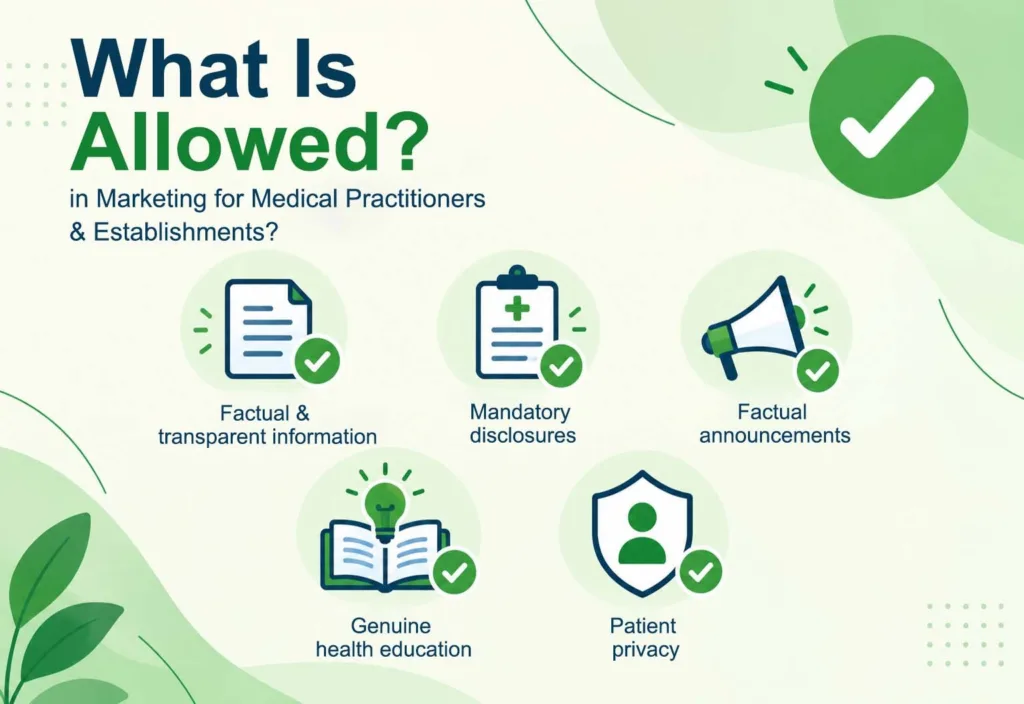
1. Factual and Transparent Information
RMPs, clinics and hospitals can proclaim their establishment name, location, contact details, timings, infrastructure, departments, services, facilities, equipment, emergency services and verified accreditations.
2. Mandatory Disclosures
When RMPs post any digital communication they must include their full name, qualification, registration status, and State or National Medical Register (SMR/NMR) number.
3. Announcements
Public notices regarding change of address, starting a new practice, temporary absence from service or declaring fee structures are permitted to be announced by law.
4. Genuine Health Education
Doctors and medical professionals can partake in public and media (TV, radio, digital) talks and lectures about public health education as well as spreading awareness about disease using their own name and designation. However, they cannot use the name or promote the organization they work for. Importantly the talks should strictly be for educational purposes.
5. Patient Privacy
Patient images, videos or case studies are to be used only for scientific or educational purposes, with their consent, and anonymity should be practiced by cropping, blurring or blacking out parts of the image wherever required.
Enforcement and Penalties Regarding the New Medical Advertisement Guidelines
The RMPs or medical institutions can be fined, suspended or removed from the medical registration if they fail to meet the new rules and regulations set by the NMC.
Penalties
RMPs will be held accountable by the State Medical Councils (SMCs) for violating the advertising guidelines and regulations. The penalties range from warnings to suspension or removal of registration, depending on the severity of the infringement.
- First Violation: warning and mandatory ethics training.
- Second Violation: censure and monetary penalties.
- Third Violation: 3 to 6 months of suspension of registration.
- Serious Violation: 6 to 12 months of suspension of registration.
- Repeat Violation: removal from medical registration for 1 to 3 years.
Hospitals
Hospitals, medical institutions and clinical establishments that do not comply with the NMC’s regulations are dealt with according to the Clinical Establishment Act.
Conclusion
The newly updated marketing guidelines and regulations by the NMC is essentially created to bridge the gap between the doctors and hospitals. As medical establishments had fewer restrictions compared to doctors practicing individually. The rules are put in place for the public to have access to the factual, transparent and verifiable information regarding healthcare.


